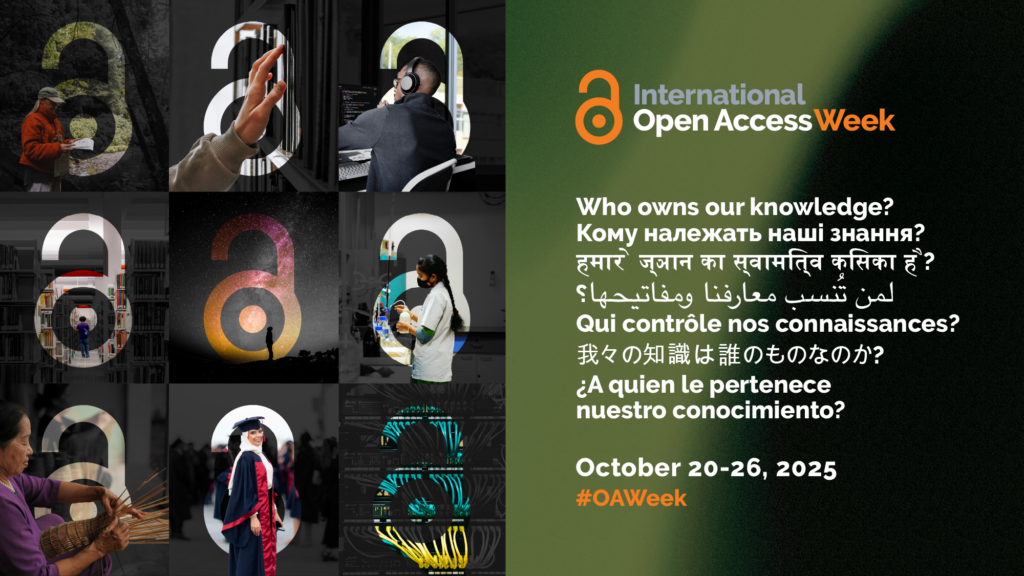
During International Open Access Week 2025, individuals around the world had critical conversations around this year’s theme of “Who Owns Our Knowledge?” and took steps toward reclaiming control of their knowledge and knowledge infrastructure. This year’s discussions and actions reflected growing momentum to reclaim not just access to research, but the fundamental infrastructure and governance of scholarly communication itself.
The events of the week underscored how communities around the world are asserting their right to determine how knowledge is shared, preserved, and built on. The conversations highlighted the need for sustainable, community-owned alternatives that keep control in the hands of researchers and their institutions – rather than commercial intermediaries.
Below, you can find a sampling of this year’s activities, actions, articles, and conversations. Click the links to listen to presentations, read posts, and learn more.
Action, Collaborations, and Resources Advancing Open Access
The Open Access Books Network released a resource, Frequently Asked Questions on Third-Party Materials in Open Access Books.
Érudit, a network that supports open digital publishing in the arts, humanities, and social sciences, shared a study, The Lasting Impact of Open Impact Journals On Érudit: More Views and a More Diversified Readership.
The Gates Foundation collaborated with creators, including Dr. Glaucomflecken and Kimberley Wilson, to raise awareness about Open Access and the importance of addressing financial barriers.
Articles and Blogs
The Hindu published “Who owns our knowledge? Rethinking scientific publishing in the AI age,” an article by Moumita Koley calling on the community of researchers in India to rethink their approach to publishing and who controls their work.
The Electronic Frontier Foundation (EFF) shared an analysis of why “Science Must Decentralize” highlighting the risks of the platformization of research infrastructure.
The International Federation of Medical Students’ Associations (IFMSA) posted a retrospective on their 2025 Open Access Week Campaign.
The Public Knowledge Project explained how it provides a distributed open-source alternative that keeps ownership in the hands of the academic community in its article, Who Owns Our Knowledge? How Communities Power the Future of Open Publishing with PKP.
Following the October 4th Annual Forum for Open Research in MENA, Andrea Chiarelli and Eleonora Colagengo reflected on the outcomes in an article, Connecting the Dots: The Case for Coordination of Open Research in the MENA Region.
The University of Aberdeen posted a blog, The Digital Black Hole: What Happens When Academic Journals Vanish – And How to Protect Your Research by Francesca Soldati.
October marked the founding anniversary and annual release of the ORCID Public Data File, a downloadable dataset that contains a snapshot of all publicly available information from the ORCID Registry.
Scottish Universities Press published a blog on A Year of Open Conversations: Celebrating the Anniversary of Our First Publication.
Recorded Presentations, Events, and Interviews Addressing This Year’s Theme
SPARC Africa organized a webinar series focused on Diamond Open Access from global and regional perspectives and the African Platform for Open Scholarship (APOS). Uploaded recordings of both sessions are available here on YouTube, as a playlist.
The International Science Council hosted a webinar Owning Our Knowledge: Non-Commercial Pathways for Open Access Publishing.
African Library and Information Associations and Institutions (AfLIA) organized the AfLIA 2025 Open Access Week Virtual Summit. Recordings for each session are publicly available on AfLIA YouTube Channel as a playlist here.
BOAI and the National Council of Rectors of Costa Rica (CONARE) hosted a discussion on Best Practices to Protect the No-Fee OA Model in Latin American. Listen to the English recording or Spanish version.
COPIM shared an Open Access Week interview with Joanne Fitzpatrick, accessibility manager for Copim/Open Book Futures at Lancaster University.
The Circe Network featured Lynne Bowker at the University of Montreal Innovation Center for a presentation entitled Accessibility to science: What role does language play?
The University Corporation for Internet Development (CUDI) recorded its OAWeek presentation on monopolies and commercial ecosystems in science ¿Quién Posee Nuestro Conocimiento? Monopolios y Ecosistemas Comerciales en la Ciencia
Open Access Australasia held three events that were all recorded for on-demand viewing. One panel discussion included SPARC’s Heather Joseph on The politics of knowledge: who controls the story and who has access to it?; a second focused on Community ownership: relation, reciprocity and responsibility; the third was Vive la revolution! Taking our knowledge back.
Indiana University Library hosted a presentation on how “exclusive databases sustain the oligopoly of academic publishers” by PKP’s Juan Pablo Alperin that called for scholar-led infrastructure.
Listen here to a recording of Indiana University’s event on The Case for University-Based Publishing – Models, Missions, and Momentum.