Building on years of work to promote Open Educational Resources in Massachusetts, higher education leaders have new evidence that investing in open materials is saving students money and improving learning outcomes.
Some of the public state universities and community colleges in Massachusetts just wrapped up a $1.3 million Open Textbook Pilot grant that is showing promising results and a new award of nearly $2 million is funding a new project to further expand OER.
In 2022, the U.S. Department of Education awarded a grant to the Massachusetts Department of Higher Education (DHE) and a consortium of six colleges and universities: Fitchburg State University, Framingham State University, Holyoke Community College, Northern Essex Community College, Salem State University, and Springfield Technical Community College.
The three-year project – Remixing Open Textbooks through an Equity Lens (ROTEL) – produced new and adapted 27 textbooks.

“The focus of the grant was to create and adapt OER textbooks that were culturally relevant, accessible and met the labor market needs around each of our schools,” said Robert Awkward, assistant commissioner for academic effectiveness for the state DHE and co-principal Investigator for the grant.
Nearly half of the new OER materials are in STEM (science, technology, engineering and math) fields. The ROTEL projects titles include a human anatomy lab manual, statistics textbook, and basics of health, wellness and fitness.
[Complete catalogue here: https://rotel.pressbooks.pub/catalog/]
Overall, an analysis of 1,603 students in 87 sections of courses that used a ROTEL resource shows an estimated savings of $187,455 over two years.
Student grade results using the customized OER were as good, if not slightly better, than non-ROTEL materials. As a result, students were more likely to succeed in class. Completion rates were 81.1% for students using ROTEL materials compared to 79.9% for students who did not. DFW rates were 24.8% for ROTEL students; 25.3% for non-ROTEL. Students earning a B+ or higher was 47.9% for those using ROTEL textbooks and 46.4% for non-ROTEL.
Student perceptions of the OER generated by the ROTEL project were also favorable.
Massachusetts has long had an active Open & Low-Cost Resources Advisory Council (OLERAC).
[See 2020 SPARC article: Inside Collaborative Effort in Massachusetts to Advance OER]
A report by OLERAC on key performance indicators and activity for fiscal year 2024 shows of the 28 undergraduate-serving institutions in the state, 26 report some data on OER use. “For every public dollar spent on OER, over $58 in savings has been generated,” according to Awkward.
The vision for the ROTEL project began with the OER Advisory Council in 2021 under the leadership of Millie Gonzalez, then dean of libraries at Framingham State University and original principal investigator. She has since moved to New York Institute of Technology where she is dean of libraries and Framingham’s Ben Atchison, took over Gonzalez’ role on the project.
Early in the grant lifecycle, it became clear that there was more interest in creating original OER than adapting existing materials. In addition, Awkward noted they underestimated the amount of support that was needed for faculty to produce books.
However, the ROTEL team partnered with the Rebus Foundation, a global nonprofit that advances OER, and provided faculty with its intensive Textbook Success Program. Experts provided training on OER development for text, pictures, examples and language that was culturally responsive and reflective of the state’s unique student populations.
Marilyn Billings, head of the Scholarly Communication Office at the University of Massachusetts Amherst, was part of the leadership team that wrote the grant proposal. Once it was clear that the group would serve as a publishing entity for the faculty, she was hired as a consultant. Billings established the ROTEL Publishing Support Team, which included a technical editor, instructional designer and copy editor to assist faculty in the OER publication process.
“Getting all those people working together as an integrated team took some effort and lots of collaborating,” Billings said. They worked remotely with faculty online and by phone addressing questions on the use of interactive media, formatting and how to make material compliant with accessibility standards such as adding alternative text for images.
A major focus of the project was on producing material that was relatable to the changing demographics of the student population at the participating institutions.
Susan Tashjian, academic innovation programs manager at Northern Essex Community College and co-principal investigator on the grant, said the project gave faculty an opportunity to co-create OER with students. “When students can see themselves and their voices reflected in a book, they are more likely to be engaged with the materials and successful,” said Tashijian, who is co-chair of the state OLER Advisory Council.
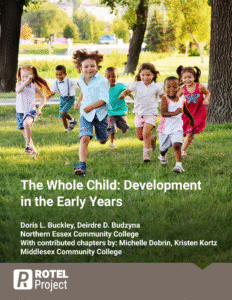
One of the new OER textbooks, The Whole Child: Development in the Early Years is published in English and Spanish, and used by early childhood faculty across Massachusetts.
At her college, childhood development faculty were very interested in creating a child development textbook in English that was translated into Spanish.
“Because we’re a Hispanic-serving institution, we offer early childhood classes in Spanish and English, so this has been an amazing resource for our students,” Tashjian said. “This is a high enrollment course in Massachusetts and all early childhood students take it, so it’s made a significant impact.”
For Atchison, a math professor at Framingham, customizing curriculum is one of the big benefits of OER. He has a diverse population of students in his algebra classes and said he likes the ability to create his own content with graphics and examples. “Anything I can do to demonstrate to students that they belong, to remind them I’m here to support them in any way – that’s why I started adopting OER,” Atchison said.
Building on the success of the ROTEL project, Tashjian applied for a second federal grant with Northern Essex Community College, UMass Lowell and Framingham State. The CA-ROTEL project secured $1.98 million in Open Textbook Pilot grant funding in 2025 to create materials that integrate artificial intelligence and career readiness into coursework.
As the new OER textbooks are widely adopted, OER leaders in Massachusetts hope the state will consider putting a line item in the state budget for open education. “This project became a proof of concept for what it takes to create these kinds of books,” Awkward said.
#