In Colorado, enthusiastic support for Open Educational Resources (OER) – from the governor to state legislators to campus administrators – has had a big impact on college affordability and student learning.
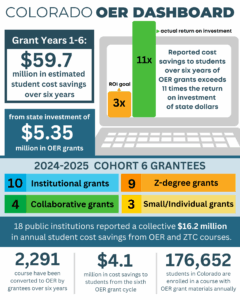
Since the Colorado Department of Higher Education began awarding OER grants in 2018, it has given $5.35 million to postsecondary institutions to expand the use of OER. As of the fall of 2025, that outlay has saved students $59 million in textbook costs – more than a 10-fold return on investment.
Chealsye Bowley, director of open education and learning innovation at the department, traces the state’s success to lawmakers’ creation of the Colorado OER Council and state OER grant program with H.B. 18-1331. Beginning with $550,000 in grants the first year, the program has awarded $1 million annually since.
Over the past six years, 2,291 courses have been converted to OER by grantees and 176,652 students in Colorado are enrolled in an OER course annually at public institutions of higher education.
Governor Jared Polis has been a long-time OER champion, Bowley said. He issued the Zero Textbook Cost (ZTC) Challenge to encourage Colorado institutions to develop pathways for students to earn a degree without paying for textbooks. Today, there are 18 zero textbook cost degrees or certificates complete, and 16 more are in progress.
“The governor and the Joint Budget Committee of the Colorado legislature have been instrumental in supporting the growth of the OER program,” said Bowley, who oversees the grant awards, runs an annual state OER conference, and coordinates OER training. It’s beneficial, she added, to have a centralized position for OER to manage activities for the entirety of the state.
Each funding cycle, the state awards general incentive, z-degree, small group, collaborative and individual grants to postsecondary institutions. Funds can be used to support the creation, adoption, adaptation, expansion, and promotion of OER for specific courses, disciplines, or programs.
In October, Bowley and members of the OER Council went on an “OER Road Show” to visit rural colleges.The traveling mini-conference provided training to faculty and librarians on finding open educational resources, copyright, and developing zero textbook cost degree programs.
While acknowledging that there isn’t a “one-size-fits-all” approach for states to roll out OER, Bowley applauds the state for setting up the OER Council by statute and requiring it to have broad representation (faculty, librarians, an instructional designer, an IT expert, an administrator and a student) to advise the Department of Higher Education and the Commission on Higher Education. “I consider them my co-conspirators. They are the best part of my work,” she said.
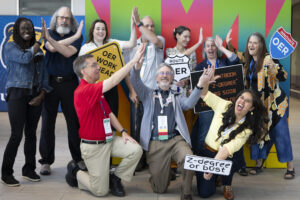 Nicholas Swails serves on the state OER Council representing Colorado Northwestern Community College. He recently traveled with Bowley to promote the state grant program to his colleagues in the OER Road Show.
As a member of the history and humanities faculty, he was part of his campus’ OER Task Force that identified the top enrolled courses and instructors who might be interested in experimenting with open pedagogy.
CNCC used its first year of $36,000 in grant funding from the state to adapt 20 OER courses that saved students $62,000. It has received OER grants every year since. Now it has 77 OER courses that have saved students $456,281 in five years, a 207% return on investment. The college offers Z degrees in its Associate of Arts and Associate of Science degrees. Courses are marked so students can search by OER when enrolling.
Surveys tracking the impact of OER reveal a 5% increase in completion rates for students in OER courses, Swails said.
Located in rural Rangely, Colorado, where the town is so small that it doesn’t have a grocery store, having OER means students don’t have to order textbooks.
“We notice students are ready on day one. They are not waiting for a textbook to arrive,” said Swails, who is now dean of academic affairs and online learning.
As faculty started building their own course materials, they collaborated with students using open pedagogy to make the material more relevant. For instance, in a lab manual, women scientists and scientists of color were incorporated into the content. Instead of referring to the velocity of a hitting golf ball in a lesson, it was changed to a football to be more relatable and less elitist.
“We’ve had that impact of social justice and shifted our mind set,” Swails said,
At the Metropolitan State University of Denver, Emily Ragan, a professor in the department of chemistry and biochemistry, has helped lead the expansion of OER.
The institution has received $470,000 in funding over the last six years to use OER course materials. The result: $7.7 million in student savings. Plus, students report high levels of satisfaction with OER and often better learning outcomes.
Ragan said she and other faculty members recognize the challenges faced by many of their students who are largely the first in their family to go to college and many of whom are Pell grant eligible.
“I’m really proud that my students don’t have to pay for any additional course materials for my class. I can provide all that they need,” said Ragan.
There are faculty benefits, too. With OER, Ragan said she enjoys being able to choose from a variety of sources to align with the learning objectives and not rely on a traditional commercial textbook.
“It can be very satisfying to create your course using OER, and it can be a lot of fun to teach,” she said.
Ragan served on the inaugural Colorado OER Council from 2017-2021, and was involved in the initial effort to secure legislature funding for OER. She said the grant money has provided training and supported faculty who want to do the work.
“It is an investment of time upfront [to use OER], and having the program that provides faculty with a stipend is very helpful,” she said. “Thanks to the state grants, we’ve really built a culture of OER.”
Ragan said she only sees the positive impact of OER growing and the upward trajectory continuing.
With more investment from the state, Bowley said she envisions even more potential. A $2.2 million annual allocation from the state legislature could translate into a total $1 billion in student savings by 2035, she added: “That would be a magic number to get to.”
The 2025 Open Education Conference will be held in Denver on Oct. 28-30.
#