Last week, SPARC heard from customers that the Copyright Clearance Center’s (CCC) Get It Now (GIN) on-demand purchasing service is being discontinued in June. This news follows recent reports that Springer Nature plans to remove its content from another popular on-demand service, Article Galaxy Scholar (AGS), by the end of March.
These on-demand purchasing services have been one component of how many libraries provide access to articles in a post-big deal environment. As more libraries leave or consider leaving big deal journal packages, hearing from libraries directly impacted by these changes may be helpful to those considering a similar approach. SPARC has compiled some initial key takeaways below and will explore these further during upcoming member events.
“This is a marketing and outreach issue—not an access issue.” After some initial concern upon learning CCC would be shuttering Get It Now (GIN), Katharine Macy (Associate Dean for Scholarly Communication & Content Strategies at the University Library of Indiana University Indianapolis) quickly realized the change was likely to have little impact on their approach. IU-Indianapolis has used GIN for years as part of their acquisition strategy to minimize big deal packages. IU-Indianapolis presents users with the choice between immediate access (within approximately 2 hours) via on-demand purchasing or access within approximately 10 hours via interlibrary loan (ILL), along with the associated cost for each.
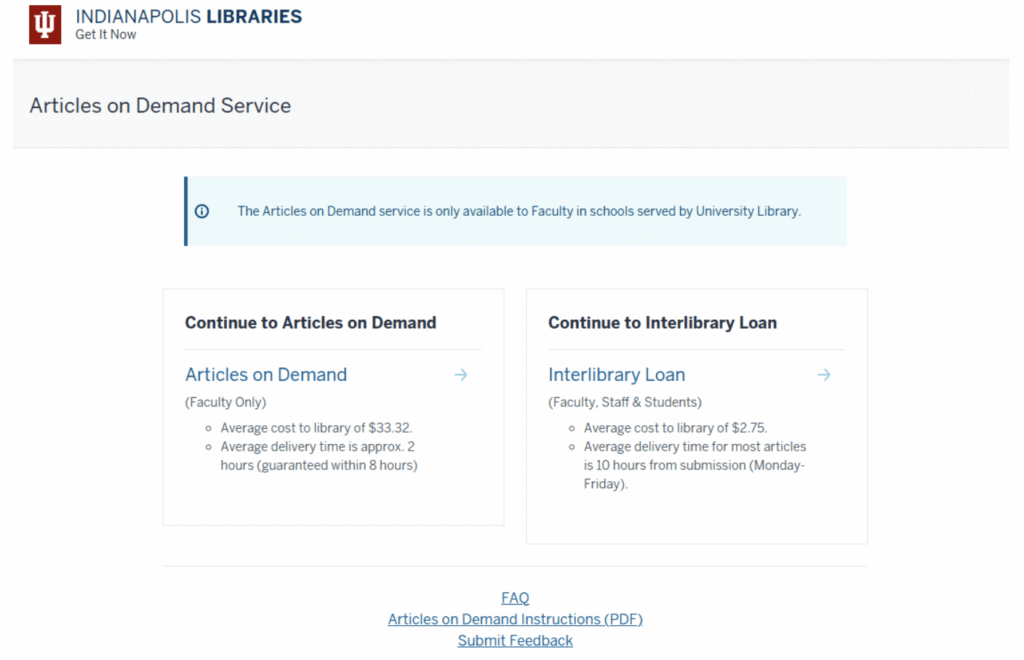 The library expects to be able to build on this approach to communicate with users and calibrate expectations—and to immediately serve up publicly available copies by automatically searching for open access copies as well as subscribed resources, where possible. Given the trend toward users choosing ILL over the more expensive on-demand service in GIN, Macy expects this change to primarily be an issue of communication and outreach to faculty—not a problem in providing access.
The data from their 10-year retrospective usage study of on-demand services backs up this assessment. The library may need to make some strategic investments in backfiles and will plan to resubscribe to specific journals if there is sufficient demand, but in general the data showed that the community is satisfied with the level of service provided by IU-Indianapolis’ ILL program.
“We’re not going back.” In speaking to a variety of libraries impacted by Springer Nature’s pulling its content from Article Galaxy Scholar, “we’re not going back” into big deals was a common sentiment in their immediate reaction. Libraries emphasized that the realities of budget cuts and the need to manage them in ways that maintained flexibility and room for strategic choices (among other reasons) meant that this development would not change their approach for the foreseeable future.
Each institution expressed confidence in pivoting to rely more on resource sharing colleagues’ expertise, particularly through expedited services like RapidILL, in addition to publicly available copies easily sourced through LibKey Nomad integrations and similar products, as well as purchases of backfiles or individual titles where needed.
Proactive conversations with faculty and university leadership about the unsustainability of academic publishing and need for change provide strategic flexibility. For each of the institutions we spoke with, the groundwork laid by numerous and ongoing conversations with faculty and administrators played an important role in enabling this approach. While this specific scenario might not have been envisioned when each library began a wider campus conversation, that understanding was a resource each could now draw on in this present moment.
Jane Strudwick (Head of Acquisitions and Discovery at the University of Connecticut Library) described UConn’s Future of Journals project to engage faculty in a conversation about the changing nature of scholarly publishing. This built support from the faculty and provost for the library in walking away from each big deal as they were up for renewal.
Katharine Macy said that similar work done by the leadership and scholcomm team at IU-Indianapolis over many years built an understanding in their community which has helped smooth the way for changes that might otherwise have been more difficult.
Involve and support colleagues managing ILL to ensure sustainability. As each library planned for a further uptick in ILL usage, the importance of involving resource sharing colleagues was another throughline. Some libraries described the need to reinvest savings of some “just in case” collection costs (resulting from fewer or more targeted subscriptions and acquisitions) in resource sharing staffing, to support those who will be carrying the burden of managing the systems and processes that deliver resources to researchers “just in time.”
Institutional experiences will vary, and local context is key. While we spoke with a selection of institutions immediately impacted by these changes, it is far from a representative sample. We recognize this and will be actively looking to hear from others navigating these issues—in our upcoming member programming and directly via email. If you have an experience or feedback to share, please reach out directly to Paolo Mangiafico at [email protected].
As we continue to track this evolving area, we’ll plan to share further updates (and potentially additional resources) with the SPARC community.