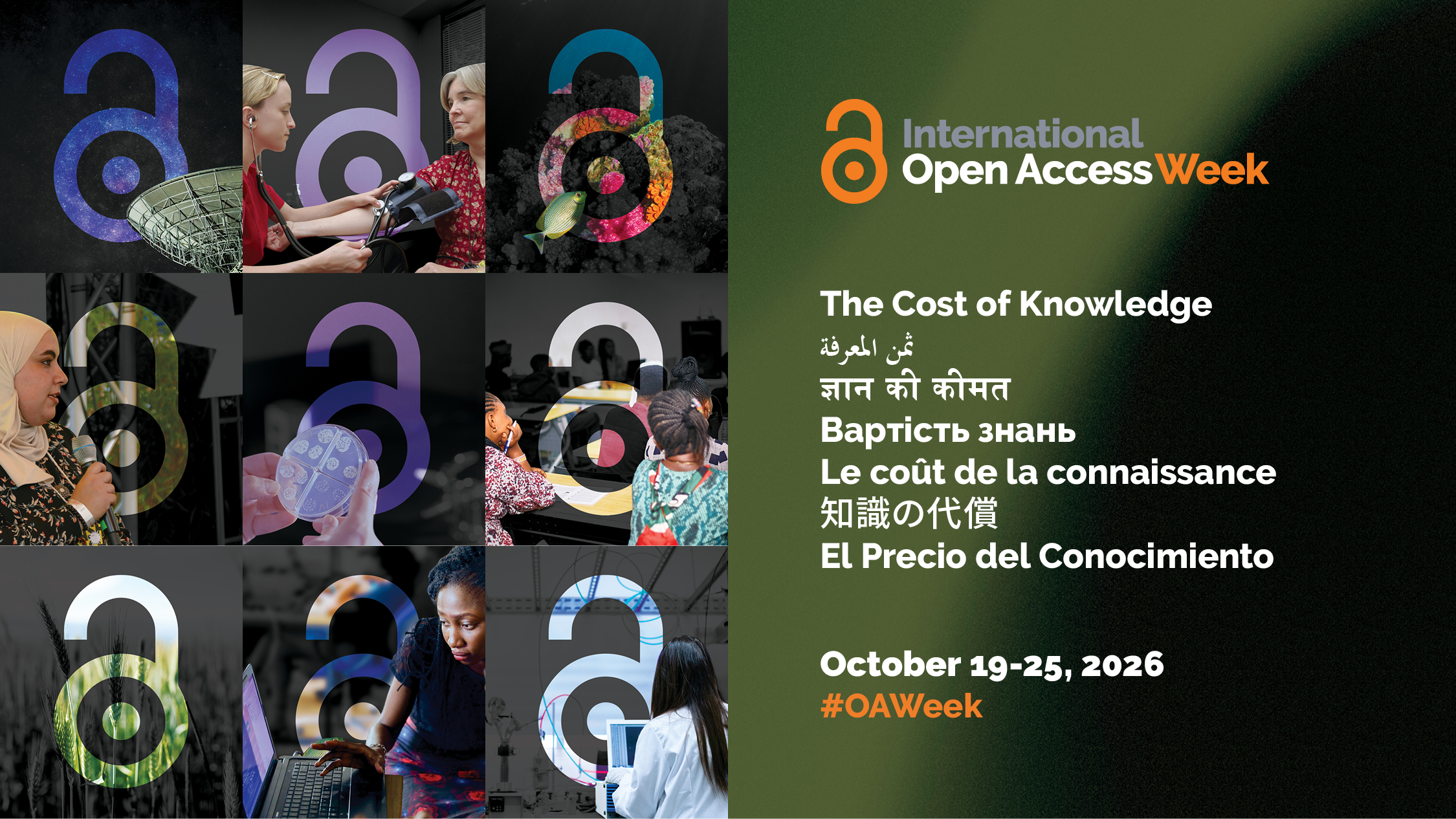
The costs to access and share knowledge continues to increase around the world. Why that is and who benefits were central to questions addressed during International Open Access Week 2026. We’ve highlighted some of the programs, reflections and resources generated from this year’s theme, “The Cost of Knowledge.”
Action, Collaborations, and Resources Advancing Open Access
The International OA Week Advisory Committee was excited to launch a new addition to this year’s OA Week, which saw the community submit resources, articles, videos, blog posts and more that support conversations around this year’s theme. Check out this new collection of Community Recommended Resources and thanks to all who submitted suggestions!
SPARC released its Cost of Knowledge Accounting Analysis and Profitability Report, along with a Cost of Knowledge Calculator.
ACRL lists several resources for libraries including free online books, webinar recordings and a scholarly communication toolkit in a post, International Open Access Week 2026.
EIFL produced a Guide to Support Diamond Open Access Publishers to enhance the quality and credibility of their journals, and to encourage alignment with established best practices in scholarly publishing.
Articles and Blogs
The Annual Reviews journal, Katina, published The Unacknowledged Cost of Knowledge, by Reggie Raju, director emeritus of research and learning services at the University of Cape Town Libraries.
Redalyc’s Eduardo Aguado López published an article, The Cost of Knowledge: The bill no one has settled.
Eduardo Aguado López and Arianna Becerril-García’s “Latin America’s longstanding open access ecosystem could be undermined by proposals from the Global North” highlight the challenges now faced by equitable OA.
Felicia Nkrumah Kuagbedzi, acting coordinator for Communications and Knowledge Management with the Association of African Universities, reflected on the OAWeek theme is a paper, “The Cost of Knowledge: Reframing What Africa Pays for Open Science“.
The University of College London posted a blog, The Cost of Knowledge: Funding Open Access Books by Lara Speicher.
The COPIM community shared its take on The Cost of Knowledge: Open Access Week 2026 in a post by Anna Hughes.
Knowledge Rights 21 posted a blog, 2026 Open Access Week: What is the Cost of Keeping Knowledge Closed by Clara Riera and Stephn Wyber.
Canadian Association of Research Libraries (CARL) gave an overview of its work in a blog post, CARL at 50: Advancing Open Access to Knowledge.
The Science Integrity Alliance published The Price of Openness: Who Pays, What It Buys and the Alternatives by Machado M, Coats JA, Walton L, Sayab M and Machado L.
The Michigan Press at the University of Michigan shared a blog post with links to several OA books, community funded journals, and articles including Why Making U-M Dissertations Freely Available Online Matters to the General Public.
Recorded Presentations, Events, and Interviews Addressing This Year’s Theme
LatinDex produced a video, Open Science – Equitable Access for Everyone.
OASPA hosted a webinar, Can Data Sovereignty and Open Access Co-Exist? Perspectives from across the Asia Pacific on the cost of open knowledge.
Knowledge Commons held a webinar that discussed some features of the coalition open knowledge coalition creators here: Empowering Open Knowledge.